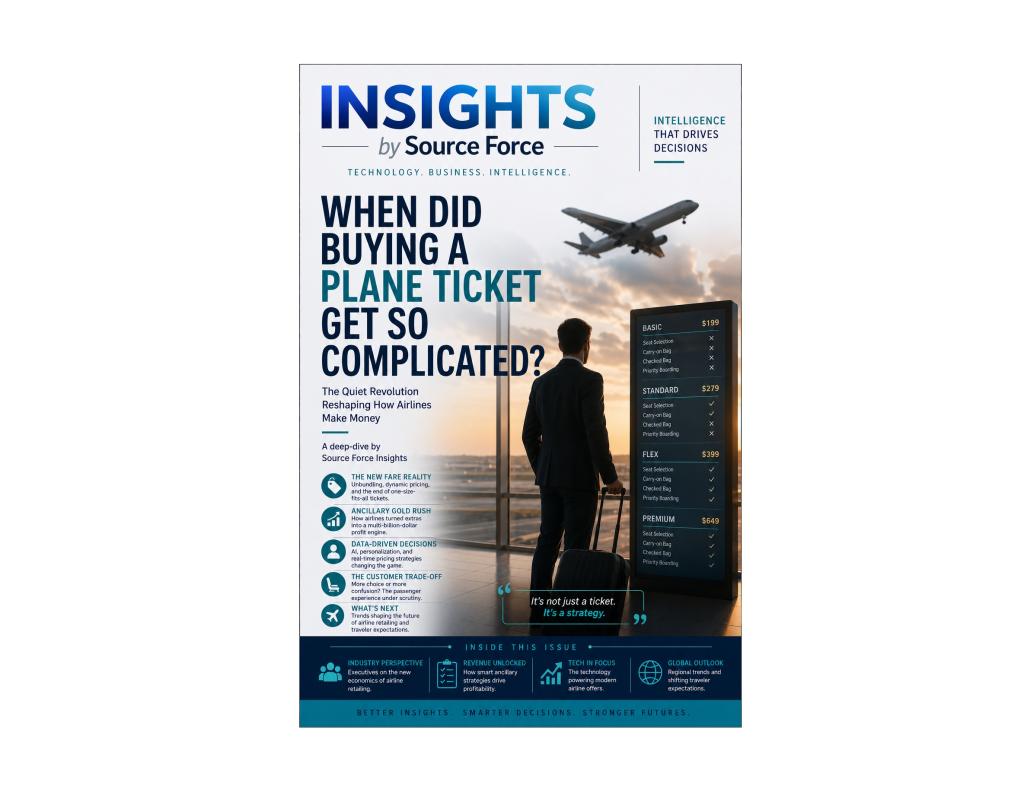
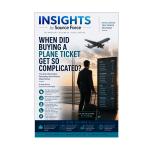
When Did Buying a Plane Ticket Get So Complicated? The Quiet Revolution Reshaping How Airlines Make Money
A deep-dive by Source Force Insights
There was a time, not all that long ago, when buying a plane ticket was genuinely simple. You called a travel agent, or later typed a destination into a website, and you got a price. That price covered your seat, your bag, maybe a meal if the flight was long enough, and the vague dignity of being treated like a paying customer rather than a variable in someone's revenue model. You handed over your money, you got on the plane, and both sides of that transaction understood what they'd agreed to.
That era is gone. And if you've booked a flight recently navigating the bewildering grid of "Basic Economy," "Standard," "Comfort Plus," "Premium Select," and whatever else the carrier has decided to call their mid-tier option this quarter you've felt its absence. What replaced it is something far more sophisticated, far more deliberately engineered, and, depending on your perspective, either a brilliant democratization of choice or an elaborate machine designed to extract every last dollar from your wallet before you've even found your seat.
This is the story of how airlines stopped selling flights and started selling experiences or at least, the idea of experiences. It's a story about technology, about human psychology, and about an industry that was, for most of its existence, structurally incapable of making consistent profits. It's also, in a strange way, a story about how the unbundling of a plane ticket became one of the most consequential developments in the modern travel industry.
The Old World: One Price, One Product, One Problem
To understand why airlines changed the way they sell tickets, you have to understand how thin the margins in this industry have always been. Aviation is a business of staggering fixed costs, aircraft, fuel, maintenance, crew, landing fees, gate leases stacked on top of deeply unpredictable demand. A seat that flies empty is revenue that can never be recovered. A seat that fills at the wrong price is almost as bad.
For decades, airlines tried to solve this with a relatively blunt instrument: price discrimination through booking windows and travel restrictions. Buying early got you a deal. Buying late cost you dearly. Staying over a Saturday night a restriction designed to separate leisure travelers from business travelers could cut your fare in half. These mechanisms worked after a fashion, but they were crude, they were opaque, and they left a lot of money on the table.
The first real disruption came from the low-cost carriers, most notably Southwest in the United States and Ryanair in Europe. Their model was radical in its simplicity: strip the product down to almost nothing, charge a fare so low it was hard to argue with, and let passengers take it or leave it. For a while, the legacy carriers struggled to respond. They couldn't easily match the fares without destroying their cost structure, and they couldn't easily differentiate on service when the service had become, for most passengers, largely indistinguishable.
The answer, it turned out, wasn't to fight the low-cost model. It was to adopt a version of it and then build something far more complex on top.
The Psychology of Choice: Why Tiered Pricing Works So Well on Human Brains
Before you can understand the technology behind modern fare bundling, it helps to understand the behavioral economics that make it work. Because airlines didn't just stumble onto tiered pricing by accident. The structure of "Basic," "Standard," and "Premium" isn't arbitrary it's the product of decades of research into how human beings make decisions under conditions of uncertainty and comparison.
The central trick is what psychologists call anchoring. When you see three options side by side a bare-bones Basic fare, a middle-tier Standard fare, and a fully-loaded Premium option your brain doesn't evaluate each one independently. Instead, it uses the other options as reference points. The Basic fare makes the Standard fare look reasonable. The Premium fare makes the Standard fare look like a bargain. The middle option, which is almost always the one the airline most wants you to buy, gets a kind of reflected glow from its neighbors.
This is why airlines almost always offer exactly three tiers, and why the price gaps between them are so carefully calibrated. If Basic costs $150, Standard $220, and Premium $400, the $70 jump from Basic to Standard feels modest. The $180 jump from Standard to Premium feels steep. Most people land in the middle which is precisely where the airline wants them.
But the deeper insight is about something called self-selection. When a passenger chooses the Basic fare, they're not just saving money; they're making a conscious declaration about their own needs and priorities. They've decided, actively, that they don't need a checked bag or an advance seat assignment or a snack. That act of choosing reduces what economists call "buyer's remorse," because the passenger feels like they've made an informed decision rather than having a price imposed on them.
Conversely, the passenger who upgrades to Premium isn't just paying for legroom. They're buying a story they tell themselves that they're the kind of traveler who prioritizes comfort, who values their time, who has earned a decent seat. Airlines have become extraordinarily good at packaging that story and selling it at a markup.
What technology has done is take these psychological mechanisms, which existed in rough form for years, and made them vastly more precise. The question is no longer just "which tier does this customer choose?" but "which specific combination of features, at which price point, is most likely to maximize revenue from this particular individual, on this particular route, on this particular day?" That question requires a very different kind of infrastructure to answer.
The Engine Room: How AI Turned Ticket-Selling Into Something More Like Retail
At the heart of the modern airline revenue operation is something called an Offer Management System, or OMS. The name is functional to the point of being almost boring, which is perhaps why the industry has started calling the most advanced versions "ancillary engines" a term that better captures what they actually do.
In their original form, these systems were essentially sophisticated pricing tools. They tracked demand, adjusted fares, and managed seat inventory. Useful, but fundamentally reactive. The newer generation of these platforms, built around machine learning and what the industry calls "agentic AI," operates on an entirely different level. They don't just respond to demand; they anticipate it, shape it, and in some cases help create it.
Here's a concrete example of how this works in practice. Imagine you're booking a flight from London to Dubai. You've searched the same route twice in the past week, which tells the system you're price-sensitive but genuinely intent to travel. Your travel history shows you've checked bags on every trip for the past three years. The current weather forecast for Dubai suggests temperatures above 40 degrees Celsius throughout your travel window. The flight you're looking at departs at 11pm.
A legacy pricing system would offer you a fare. The modern ancillary engine does something different: it constructs a personalized offer. It knows, from the pattern of your searches, roughly what you're willing to pay for the base fare. It knows you'll almost certainly need to check a bag. It can infer from the late departure and your travel history that you're a relatively frequent flier who might value lounge access. And it knows that first-time visitors to Dubai in summer a category your booking pattern might fit often add travel insurance at higher rates than the average customer.
So instead of presenting you with a bare fare and a menu of add-ons, the system bundles them into an offer that feels, to you, like a single coherent product. You see "Premium Economy Bundle includes checked bag, lounge access, and travel insurance." The total price might be $40 more than purchasing those components separately, but because you're comparing it to a bundle rather than to individual line items, the value calculation in your head runs differently. You're not asking "is this insurance worth $18?" You're asking "is this whole package worth it?" And the answer, for many customers, is yes.
This is what the industry means by "retail orchestration" a term borrowed from the world of e-commerce, where the best platforms have long understood that presenting the right product to the right customer at the right moment is worth more than any individual item in the catalogue. The airline, in this model, is no longer just selling seats. It's curating a shopping experience, in real time, for every individual customer simultaneously.
Breaking Open the System: The Distribution Revolution That Made All of This Possible
None of this personalization and dynamic bundling would be technically possible without a fundamental change in how airline fare information travels through the distribution chain. And that change, while largely invisible to most passengers, has been one of the most significant infrastructure shifts in the industry's history.
For most of aviation's modern era, the global distribution systems the enormous, decades-old technology networks that connect airlines to travel agents and booking sites were the unavoidable middlemen of the industry. These systems, built in an era when the most advanced communication technology was a telephone, were designed to transmit exactly one thing: a price and an availability. Not a description of the seat. Not a photo of the cabin. Not a real-time count of how many upgrades were still available. Just a number.
This created a strange and persistent bottleneck. Airlines could develop ever-more-sophisticated offers, but those offers could only reach customers through distribution channels that couldn't carry the information needed to explain or sell them. It was, in an analogy that dates to the same era, like having a high-definition television but being forced to broadcast in black and white because the cables weren't capable of handling color.
The solution developed through the International Air Transport Association and gradually adopted by most major carriers over the past decade is called New Distribution Capability, or NDC. The technical details are complex, but the commercial implication is straightforward: airlines can now push rich, dynamic content directly through the distribution chain. Photos of seat configurations. Videos showing the meal service. Real-time pricing that responds to demand signals in seconds rather than hours. And critically, personalized offers that can be tailored to specific customers rather than presented as a generic menu.
The impact on conversion rates for ancillary products has been significant. When a travel agent or an online booking tool can show a traveler a high-quality image of the actual seat they're considering upgrading to complete with measurements, a view of the window, and a comparison to their current selection the decision to spend the extra money becomes meaningfully easier to make. The product becomes real in a way that a text description never quite manages.
For airlines, this is transformational. The distribution channel is no longer a constraint on what they can sell. It has become part of the sales floor.
The Add-On Economy: How Ancillary Revenue Became the Real Business
It's worth pausing to appreciate just how much the economics of airline revenue have shifted over the past fifteen years or so. When airlines first started charging separately for checked bags a move that was met with genuine public outrage when it began around 2008 it looked like a desperate measure by a struggling industry. It was, in fact, the beginning of a structural transformation.
Today, ancillary revenue the money airlines make from everything except the base fare accounts for a substantial portion of the total revenue at most major carriers. For some ultra-low-cost carriers, it represents the majority of their profitability. The base fare has, in the most literal sense, become a loss leader: a number kept artificially low to attract customers who will then spend considerably more once they've committed to the booking.
This shift has been enabled, at every stage, by technology. The ability to offer, process, and fulfill ancillary products at scale across millions of bookings, on hundreds of routes, with real-time pricing and inventory management was simply not possible with earlier-generation systems. The infrastructure built over the past decade has made the economics of selling a $12 seat upgrade or a $25 priority boarding pass across the entire network not just viable but highly profitable.
The product range has also expanded far beyond what most passengers probably realize. The obvious ancillaries bags, seats, food are only the most visible layer. Airlines now sell everything from airport transfer bookings and hotel recommendations to travel insurance, currency exchange, and destination activity packages. Some carriers have gone further still, building marketplace platforms where third-party vendors can sell directly through the airline's app and website, with the airline taking a commission on every transaction.
The logic here is borrowed directly from the platform economy. An airline's app is, at the moment of booking, one of the highest-intent shopping environments on the internet. The person using it has already decided to travel, has already chosen their destination, and is already in a mindset of planning and preparation. That's a remarkably valuable context for selling almost anything related to that journey. The airlines that have recognized this earliest have built meaningful new revenue streams that have nothing to do with the aircraft itself.
The Next Frontier: Dynamic Bundling and the “Bundle of One”
Everything described so far the tiered fare structures, the personalized offers, the expanded ancillary catalogues is already operational at most major carriers. The technology behind it is mature enough that competitive differentiation increasingly comes from execution rather than concept.
The next wave of development, already beginning to emerge in 2026, goes further. It's called dynamic bundling, and it represents the logical endpoint of the personalization trajectory: a world in which the bundle is constructed entirely in real time, for a specific individual, and doesn't exist as a pre-packaged product at all.
Under the current model, airlines still operate with a finite set of tier configurations. There might be fifteen or twenty different bundle templates in any given market, customized by route and season, but the fundamental architecture is fixed. A passenger's options are shaped by which template the system assigns them to. Dynamic bundling eliminates that constraint. Instead of choosing from templates, the AI constructs a unique offer from individual components seat selection, baggage allowance, meal preference, lounge access, priority boarding, travel insurance, whatever else is in the catalogue and prices it specifically for the individual in front of it.
The commercial benefit to the airline is obvious: if the system knows exactly how much each component is worth to each customer, it can maximize the value of every transaction without leaving money on the table or pushing the price above what the customer will pay. But the theoretical benefit to the customer is also real, if the technology works as intended: a passenger who genuinely doesn't care about in-flight food but values flexible rebooking should, in theory, be offered exactly that combination, rather than a bundle that packages services they'll never use.
Whether this theoretical alignment of airline and passenger interests actually materializes in practice is, to put it diplomatically, an open question. The same technology that could be used to construct "the perfect bundle for you" can also be used to identify the maximum price each individual will tolerate and charge them accordingly. The line between personalization and price discrimination is thin, and the incentives of a profit-maximizing business push clearly in one direction.
What This Means If You're Buying a Ticket
For the ordinary traveler, the practical implications of all this are worth understanding. The feeling that buying flights has become complicated and vaguely adversarial is not a misperception. The systems on the other side of your booking are sophisticated, data-driven, and designed to maximize what you spend. That doesn't mean they're always working against your interests a bundle that genuinely packages services you need at a price lower than buying them separately is a real consumer benefit but it does mean the naive assumption that the lowest headline fare is the best deal is increasingly unreliable.
A few things are worth keeping in mind. The base fare, especially at ultra-low-cost carriers, is often calibrated to look attractive while the full cost of the trip depends on add-ons that are, at the point of booking, somewhat coercive the middle seat with no carry-on allowance is the most common example. Understanding what you actually need for a trip before you start comparing fares is more valuable than it used to be.
The bundled tiers, counterintuitively, are sometimes the better deal. Because airlines price individual ancillaries to maximize revenue, and bundles to maximize conversion, the math can favor the bundle in ways that aren't immediately obvious from comparing line items. It's worth doing the arithmetic rather than assuming that unbundled is always cheaper.
And the personalization is real, which means the price you see may not be the price someone else sees for the same seat. Dynamic pricing based on individual data is widespread, and the variation between offers can be significant. Using different browsers, clearing cookies, or searching from different devices are imperfect mitigations, but they're not without effect.
A Structural Shift, Not a Passing Trend
The transformation described in this article didn't happen overnight, and it isn't going to reverse. The economics of aviation thin margins, high fixed costs, fierce competition on price make the expansion of ancillary revenue not just commercially attractive but genuinely necessary for most carriers. An airline that sells only seats in a world where its competitors are selling complete travel experiences is competing with one hand tied behind its back.
What has changed, and will continue to change, is the sophistication of the tools involved. The offer management platforms are getting smarter. The distribution infrastructure is getting richer. The data available to personalize offers is getting more granular. The gap between what airlines know about their customers and what customers know about airlines is, if anything, widening.
For the industry, the trajectory points toward something the strategists call "total retail" a vision in which the airline becomes the primary commercial interface for the entire journey, from the moment a trip is contemplated to the moment the traveler returns home. In that vision, the aircraft itself is almost incidental. It's the platform for a retail relationship that extends well beyond the flight.
Whether that vision serves travelers as well as it serves shareholders is a question the industry is still, in its way, working out. The technology is neutral. The incentives are not. And the answer will depend, ultimately, on how much the people buying the tickets understand what they're really buying and how much that understanding changes what they're willing to pay for.
Source Force Insights covers technology, economics, and strategy across the global travel and aviation industries.
Disclaimer
General Notice: The analyses, forecasts, and strategic frameworks presented in Insights by Source Force are intended for informational and educational purposes only. While our editorial team utilizes high-fidelity data, agentic modeling, and expert interviews to ensure accuracy at the time of publication, the rapid evolution of technology, global markets, and regulatory landscapes means that outcomes may vary.
No Investment Advice: Content within this publication does not constitute financial, legal, or investment advice. Mention of specific platforms, startups, or technologies (including but not limited to AI agents, blockchain protocols, or aerospace entities) should not be construed as an endorsement. Readers and stakeholders are strongly encouraged to perform independent due diligence and consult with qualified professional advisors before committing capital or altering corporate strategy based on these insights.
Data Sovereignty & AI Disclosure: Portions of the research and data synthesis in this issue were assisted by advanced Agentic AI workflows. All AI-generated insights have been rigorously audited and refined by our human editorial board to maintain the "Source Force Standard" of journalistic integrity and technical depth.