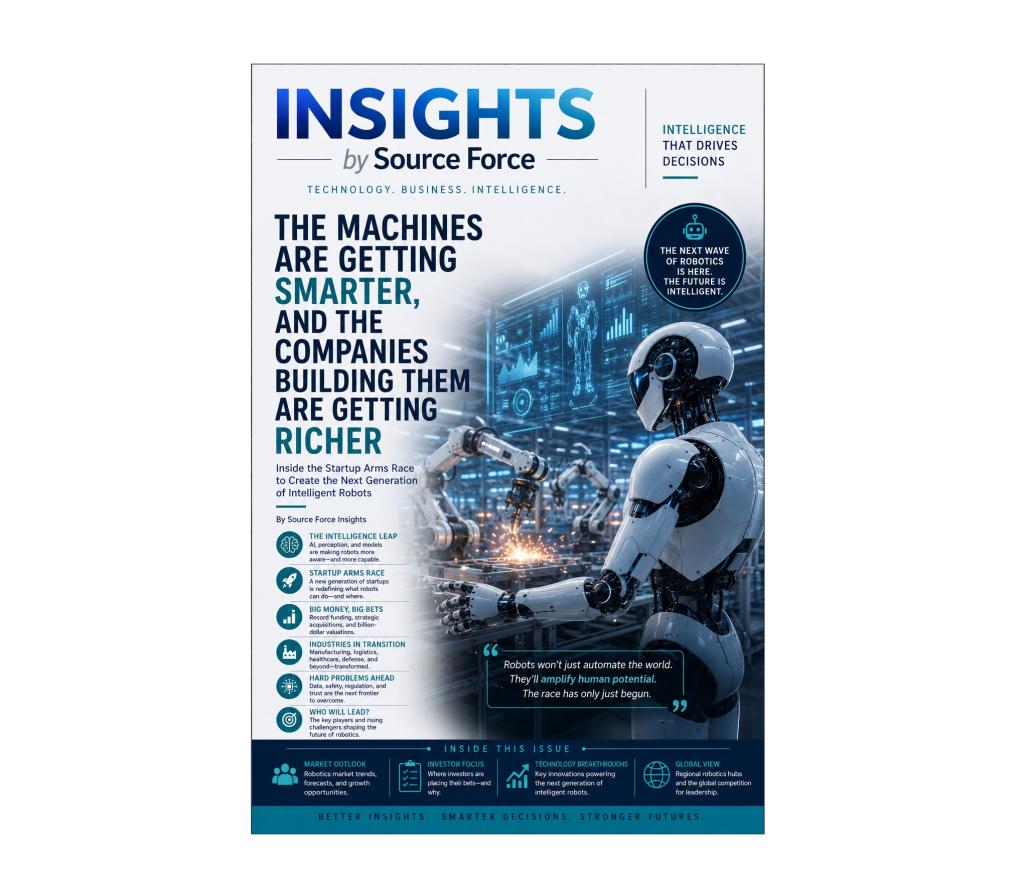
The Machines Are Getting Smarter , and the Companies Building Them Are Getting Richer
Inside the Startup Arms Race to Create the Next Generation of Intelligent Robots
By Source Force Insights | June 2026
There is a moment, if you watch enough robotics demonstration videos, when the uncanny valley starts to feel less unsettling and more inevitable. The robot reaches for the object. It adjusts its grip mid-motion. It recovers from a stumble that would have floored a previous generation of machine. And somewhere in the back of your mind, a threshold quietly shifts this no longer looks like a lab curiosity. It looks like a colleague.
That shift, subtle as it is in any individual video, is the story of the robotics industry in 2026. After decades of incremental progress, of impressive hardware constrained by brittle software, of machines that could weld a car door with extraordinary precision but couldn't pick up a towel off the floor, something fundamental has changed. The fusion of modern artificial intelligence with physical robotics hardware has created capabilities that simply did not exist three years ago. Robots are learning, adapting, generalizing. They are moving from the controlled environment of the factory floor to the chaotic, unpredictable world the rest of us actually live and work in.
The investment community has noticed. In Q1 2026 alone, robotics startups secured over $2.26 billion in funding, with more than 70 percent going to firms focused on warehouse and industrial automation. The global robotics market reached $73.64 billion in 2026 and is forecast to expand to $185.37 billion by 2030. These are not the numbers of a niche technology sector finding its footing. These are the numbers of an industry that investors believe is about to change the way the world works.
But markets, as anyone who has watched a technology cycle knows, are not always right about timing, and they are almost never right about which specific companies will emerge as the lasting winners. The robotics space in 2026 is extraordinary in its ambition and genuinely impressive in its technical progress. It is also, in places, deeply speculative companies valued at billions of dollars with minimal revenue, partnerships described as commercial deployments that are, on closer inspection, still essentially pilots, and a hardware manufacturing challenge that is fundamentally different from anything the software-native investors backing these companies have ever navigated before.
This report is an attempt to cut through both the hype and the skepticism. To look at the companies doing the most interesting work, understand what they are actually building and who is actually buying it, and assess honestly what is real and what is still a bet on a future that hasn't arrived yet. The roster is extraordinary. The technology is, in many cases, genuinely extraordinary too. What remains to be seen is whether extraordinary technology can become an extraordinary business and how long that transition will take.
Why Now? The Convergence That Changed Everything
Before examining individual companies, it is worth spending a moment on the question that underlies the entire sector's current excitement: why is this happening now? Industrial robots have existed for decades. Computer vision has been maturing for fifteen years. What changed?
The honest answer is that several things changed simultaneously, and their combination was more powerful than any single advance could have been alone. Large language models and the broader AI revolution of the early 2020s produced, among other things, a new approach to teaching machines how to handle variability. The previous paradigm for programming robots required extraordinarily detailed, hand-coded instructions for every possible scenario a robot might encounter. If the assembly line changed, the robot had to be reprogrammed. If a box arrived at an unexpected angle, the robot might fail. This brittleness was the fundamental constraint on where robots could be deployed it limited them to the highly controlled, highly repetitive environments where variability could be engineered out.
The new paradigm is learning-based rather than rule-based. Instead of programming a robot to handle a specific object in a specific orientation under specific lighting conditions, you train it on vast quantities of data , sensor readings, camera feeds, human demonstrations, simulated environments and let it develop something that functions more like general competence than specific capability. The robot doesn't know the rule for picking up a coffee cup at a thirty-degree angle. It has simply picked up enough objects in enough contexts that it has internalized something like physical intuition.
This shift, which sounds conceptually straightforward, required the development of enormously powerful foundation models specifically designed for physical tasks rather than language tasks along with the compute infrastructure to train them and the manufacturing know-how to put them in a body that could survive real-world conditions. The companies doing this work have attracted some of the largest private funding rounds in technology history. Some of them are building the robots. Some of them are building the brains. And some of them, most ambitiously, are trying to build both.
Figure AI: The Most Valuable Bet in the Room
If you had to pick a single company to represent the audacity of the current robotics moment, Figure AI would be a strong candidate. Founded in 2022 by Brett Adcock a technology entrepreneur who previously co-founded Archer Aviation and Vettery Figure AI is an AI robotics company developing humanoid robots designed to work alongside humans in real-world environments. The company is four years old. It is now valued at $39 billion.
In September 2025, Figure exceeded more than $1 billion in committed capital through its Series C financing round, at a post-money valuation of $39 billion. The round was led by Parkway Venture Capital with significant investment from Brookfield Asset Management, NVIDIA, Macquarie Capital, Intel Capital, Salesforce, T-Mobile Ventures, and Qualcomm Ventures. That list of investors is notable not just for its size but for its composition. These are not purely financial bets. Strategic investors like NVIDIA, Qualcomm, and Salesforce are buying into a platform they believe will become infrastructure for a much larger ecosystem. When NVIDIA invests in a robotics company, it is partly because it believes that company's robots will run on NVIDIA chips and NVIDIA simulation platforms.
The company's core product is the Figure 03, a general-purpose humanoid robot designed for commercial deployment in manufacturing, warehousing, and logistics environments. The robot is built around a proprietary AI platform called Helix, which handles the real-time decision-making that translates sensor input into physical action. Figure has been notably aggressive about commercialization relative to many of its peers Figure has deployed its robots with a paying customer since December 2024, and its partnership with BMW has moved from pilot to active production support.
What distinguishes Figure's approach, beyond the scale of its funding, is the speed with which Adcock has pushed toward commercial deployment rather than staying in perpetual development mode. The robotics industry has a long history of impressive demonstrations that never become real products, and Adcock has been vocal about his impatience with that pattern. The company built its own manufacturing facility BotQ specifically to control the production timeline and avoid dependence on third-party manufacturers who might not be able to move at the pace the company requires.
The valuation, of course, demands scrutiny. Thirty-nine billion dollars is a remarkable number for a company that is still in the early stages of commercial deployment. It implies a belief shared by some of the most sophisticated technology investors in the world that Figure will scale to a level of production and commercial adoption that currently does not exist anywhere in the industry. The bet is not on what Figure is today. It is on what it becomes when humanoid robots are as common in warehouses as forklifts. Whether that future arrives in three years or fifteen, and whether Figure leads it or someone else does, is the question every investor in the space is effectively placing a bet on.
Skild AI: The Brain Without a Body and Why That Might Be the Smarter Play
Skild AI takes a fundamentally different approach to the same opportunity, and the contrast is illuminating. While Figure, Agility, Apptronik, and others are racing to build complete robot systems body and brain together Skild has bet that the most valuable thing in the robotics industry isn't any particular robot. It's the intelligence that runs on all of them.
Skild AI is building the industry's first omni-bodied brain to operate any robot for any task a general foundation model for physical AI. The company will continue to focus on scaling its foundation model for future enterprise and commercial deployments. The core product is called the Skild Brain, and the ambition behind it is genuinely radical: a single AI model that can control any robot quadrupeds, humanoids, tabletop arms, mobile manipulators without being specifically trained on that robot's body or task profile.
Unlike traditional AI models that are tailored to specific robot designs, the foundation model is intended to be "omni-bodied" and to control any robot without prior knowledge of its exact body form. The Skild Brain enables robots to handle everything from simple household chores like cleaning, loading a dishwasher, and cooking an egg to physically demanding challenges such as navigating slippery terrain. More remarkably, the Skild Brain can control robots it has never trained on, adapting in real time to extreme changes in form or environments including recovering from hardware failures like jammed wheels or increased payload without retraining.
The funding numbers reflect just how seriously the market is taking this approach. Skild AI raised close to $1.4 billion in funding led by SoftBank Group, with participation from NVentures (NVIDIA's venture capital arm), Macquarie Capital, Jeff Bezos through Bezos Expeditions, and 1789 Capital. This Series C, which closed in January 2026, gave the company a $14 billion valuation. Additional strategic investors include Samsung, LG, Schneider Electric, and Salesforce Ventures each with a direct downstream revenue interest in the platform succeeding.
Since its founding in 2023, the company grew from zero to about $30 million in revenue in just a few months in 2025, and is growing rapidly with multiple customers. For a company with no hardware to manufacture and no physical supply chain to manage, that growth rate suggests that robot operators across multiple industries are genuinely willing to pay for better intelligence, separate from whatever body their robots happen to be wearing.
The strategic logic here deserves careful attention. Skild AI's revenue model is software licensing, not hardware manufacturing. Software revenue is recurring, scales without proportional cost increases, and carries higher gross margins than hardware manufacturing. In a world where robot hardware is gradually commoditizing where the cost of a capable humanoid body is falling from hundreds of thousands of dollars toward tens of thousands the software intelligence layer may turn out to be where the durable economic value concentrates. Skild is essentially making the same bet that happened in the PC industry: hardware becomes cheap and interchangeable; software becomes the platform everyone depends on.
Whether the Skild Brain can deliver on its technical promise at scale whether a truly generalist robot intelligence can match the performance of purpose-built systems in the high-stakes, real-money environments that enterprise customers care about is the company's central challenge. The early signs are encouraging. The business model, if it works, is exceptional.
Agility Robotics: The One That's Actually Working
In a sector full of impressive demonstrations and ambitious projections, Agility Robotics occupies a distinctive position: it is the company that has done it for real. Not in a controlled lab. Not in a curated media event. In actual commercial warehouses, handling actual goods, day after day, for actual paying customers.
Agility Robotics makes the Digit humanoid robot and has moved over 100,000 totes in real warehouse operations with GXO Logistics and Amazon. The company operates a 70,000-square-foot manufacturing facility with capacity for 10,000 units per year. That last number is worth sitting with: ten thousand units per year, from an existing facility, ready to scale. Most of Agility's competitors are still talking about production capacity in the future tense. Agility has built it.
In February 2026, Agility signed a Robots-as-a-Service agreement with Toyota Motor Manufacturing Canada following a successful pilot. Seven-plus commercial units are now active supporting RAV4 logistics. The Toyota deployment is significant because it extends Agility's commercial record beyond logistics and into automotive manufacturing a harder, more demanding environment where the consequences of robot failure are more severe and the tolerance for unreliability is lower. The fact that Toyota moved from pilot to signed agreement is an endorsement that means something.
Agility's Digit robot is not the most visually striking humanoid in the market. It lacks the uncanny human-likeness of some competitors. But it was designed with a specific, pragmatic philosophy: build for the warehouse, not for the conference stage. Digit's proportions and capabilities are optimized for the environments where it actually works, not for the aesthetic of a technology showcase. That pragmatism, which might seem like a limitation compared to more ambitious humanoid designs, is arguably why Agility is the leader in real-world deployment when many of its peers are still in pilot phases.
The company's majority ownership by Amazon is both a strength and a complication. It provides access to one of the world's largest logistics networks as a testing and deployment environment an advantage that is essentially impossible for independent competitors to replicate. But it also means Agility's commercial disclosures are more limited than those of independent companies, and it raises questions about whether Agility's innovations will remain available to the broader market or become proprietary infrastructure for Amazon's competitive advantage. For the moment, the company continues to operate commercially across multiple customers, suggesting the latter concern has not yet materialized.
Apptronik: The Austin Challenger with a Very Famous Backer
Apptronik's February 2026 funding announcement did something unusual in a sector that had grown somewhat accustomed to enormous numbers: it surprised people anyway. The Austin-based company raised $520 million in a Series A round at a $5 billion valuation, bringing its total funding to $935 million. The round was led by strategic investors including Google, with participation from Mercedes-Benz, B Capital, AT&T Ventures, John Deere, and the Qatar Investment Authority.
Google's involvement is particularly notable. The search giant has a complex and somewhat turbulent history with robotics it acquired Boston Dynamics in 2013, sold it four years later, and has watched from the sidelines as the sector has been transformed by AI. The decision to lead Apptronik's round suggests a renewed conviction that physical AI is going to matter, and a belief that Apptronik's approach offers something worth betting on at scale.
Apptronik's Apollo robots are already deployed in several factories and warehouses under strategic partnerships with companies like Mercedes-Benz, GXO Logistics, and Jabil. These robots operate within predefined areas using sensors and light curtains to ensure safe interaction with human workers. The robots pause when a human crosses into their operational space, with plans for more advanced collaborative capabilities. The current deployments are still relatively early-stage the robots operate in defined zones rather than freely navigating shared human workspaces but the transition from zero to paying pilots in multiple industrial environments represents meaningful progress.
Apollo is a 5-foot-8, 160-pound bipedal robot built for industrial environments. Apptronik integrates its Apollo humanoid robot with NVIDIA's Project GR00T foundation model to enable learning complex tasks from text, video, and human demonstrations. Apollo's computing system incorporates NVIDIA Jetson AGX Orin modules for on-device intelligence. The use of NVIDIA's platform is common across the sector it has effectively become the default computing backbone for serious robotics development but Apptronik's integration has been particularly tight, and the partnership with Google DeepMind adds another layer of AI capability that most competitors cannot easily access.
Apptronik CEO Jeff Cardenas has positioned the company explicitly against Chinese competitors, stating that the funding is intended to "beat Chinese humanoids to market" an acknowledgment that the competitive threat from Chinese robotics companies is being taken seriously at the highest levels of the US industry. This framing, while commercially understandable, also reflects a genuine reality: Chinese robotics companies are scaling fast, pricing aggressively, and operating in a policy environment that actively encourages industrial automation. The race is not just between American startups. It is, at least in part, a national competitiveness story.
1X Technologies: The Home Humanoid Bet
Every technology category has one company that takes the longer, harder, stranger bet the one that isn't trying to solve today's industrial problem but is instead positioning for the consumer market that doesn't quite exist yet. In the humanoid robotics sector, that company is 1X Technologies.
1X Technologies was founded in 2014 in Norway, originally as Halodi Robotics, and rebranded in 2022 with a pivot to home robotics. While virtually every other serious player in the humanoid space has focused on warehouses, factories, and logistics environments with clear economic incentives for automation and a relatively controlled operating context 1X has spent years developing robots for the home environment, which is categorically harder, messier, and less economically legible than any industrial setting.
1X Technologies is accepting pre-orders for home humanoid robots at $20,000 or $499 per month, targeting a 2026 US launch after more than eight years of development. The pricing is striking not because it is cheap, but because it actually exists. Most companies in the space carefully avoid publishing consumer prices because the economics of home robotics haven't been worked out yet. 1X has committed to a number, built a subscription option to lower the barrier to adoption, and set a delivery timeline. That takes a certain kind of confidence.
The company has funding from EQT Ventures, Samsung NEXT, Tiger Global, and notably the OpenAI Startup Fund. OpenAI's involvement is not incidental the company's language model capabilities are becoming increasingly central to how home robots will interact with human users, and an OpenAI-backed home robot has a significant integration advantage when it comes to natural language understanding and conversational interaction.
The home robotics market is, by any honest assessment, significantly further from commercial reality than the industrial market. The range of tasks a useful home robot would need to perform, the variability of home environments, the privacy implications of an AI-powered robot in a living space, and the challenge of building something that non-technical consumers can actually set up and maintain are all formidable barriers. But they are not insurmountable, and 1X's eight years of development gives it a head start that competitors who pivot to the consumer market later will struggle to close.
Skild vs. the Hardware Builders: A Philosophical Divide
It is worth pausing on the structural question that runs through the entire sector: where does the value ultimately sit in the hardware or the software? The answer has enormous implications for which companies are worth the valuations they currently carry and which are likely to see those valuations compressed as the market matures.
The historical pattern in robotics has been that hardware companies capture the majority of revenue and control the customer relationship, while software providers are squeezed between the hardware OEM and the enterprise buyer. This pattern has driven mediocre economics for robotics software companies for decades. The current wave of AI-native companies, particularly Skild, is betting explicitly that this pattern will break that the intelligence layer will become so valuable, and so differentiated across providers, that enterprise customers will pay a premium for the best model regardless of which hardware they're running it on.
The global robotics market hit $73.64 billion in 2026 but the margin story is shifting from hardware OEMs to software platforms. The evidence for this thesis is, at the moment, largely circumstantial Skild's revenue growth is impressive but early-stage, and the large strategic investors in its round are betting on a future that is still being built. But the analogy to the smartphone industry is hard to resist: when Apple and Google turned the phone into a software platform, the hardware manufacturers who couldn't control the software layer saw their economics steadily eroded. If something similar happens in robotics if the Skild Brain or a successor becomes the iOS or Android of physical machines the companies that controlled only hardware will find themselves in an uncomfortable position.
The China Factor: Unitree and the Volume Game
No account of the robotics startup landscape in 2026 is complete without a serious treatment of Chinese competition. Western coverage of the sector has a tendency to focus on the US and European companies that generate the most media attention, while systematically underweighting the pace and scale of Chinese development. This is a mistake that investors and industry observers are increasingly aware of.
Unitree Robotics, based in Hangzhou, achieved unicorn status in June 2025 following a funding round led by ByteDance, Alibaba, and Tencent that valued the company at $1.3 billion. Unitree's approach differs fundamentally from Western competitors. Where Figure, Agility, and Apptronik are developing purpose-built industrial robots with narrow task focus, Unitree has pursued volume and cost. The company shipped approximately 5,500 units in 2025 across its product line and is targeting between 10,000 and 20,000 units in 2026.
Those shipment numbers are not hypothetical targets announced in a press release. Unitree's H1 and G1 humanoid robots are real products that real customers have received and are operating. The unit economics are dramatically different from Western competitors Unitree's G1 humanoid is available at prices that make Western alternatives look expensive by comparison and while the AI capabilities lag behind the most advanced US-developed systems, the gap is narrowing.
The cheapest humanoid robot in 2026 now costs just $5,900, a number that would have seemed implausible three years ago. That price point comes from the Chinese market, and it represents a competitive dynamic that the high-valuation US startups will need to contend with as they attempt to scale their commercial deployments. Being the most capable robot in the world is commercially meaningful only if the price premium the capability commands exceeds the cost differential. In some enterprise applications, where reliability and performance justify significant cost premiums, US companies will hold their position. In others, where the task is simpler and price matters more, the Chinese volume players may win.
NVIDIA: The Picks-and-Shovels Play Nobody Is Calling a Robotics Company
Any honest survey of the robotics startup ecosystem has to include a discussion of NVIDIA, not because it is a startup but because it is perhaps the single most important company in determining which startups succeed. NVIDIA has positioned itself as the essential infrastructure provider for the entire industry the company that sells the GPU compute, the simulation environment, the AI training platform, and the embedded computing modules that most of the leading robotics companies run their systems on.
NVIDIA's Isaac robotics platform supports the development and deployment of robots for various industries. It can be used for creating virtual environments for testing robots and managing fleets of robots. NVIDIA's artificial intelligence technologies, like the Jetson Orin AI computer, are capable of powering autonomous machines. The Isaac simulation platform in particular has become central to how robotics companies train their AI systems the Isaac Sim platform trains robots at 1,000 times real-time speed in GPU-accelerated simulation, making it possible to generate the vast quantities of training data that foundation models require without having to run physical experiments.
NVIDIA's strategy in robotics mirrors its strategy in data center AI: provide the platform that everyone builds on, collect margin at the infrastructure layer, and participate in the upside through strategic investments in the most promising companies. The company is an investor in Figure AI, Skild AI, Agility Robotics, and numerous others, creating a portfolio that gives it exposure to the success of the sector regardless of which specific companies emerge as market leaders. It is, in the classic formulation, selling shovels during a gold rush and doing so from a position of near-monopoly on the most important category of shovel.
What the Science Actually Says: Limitations the Marketing Won't Tell You
The enthusiasm surrounding robotics startups in 2026 is not without foundation, but it is also not without risk of oversell. Several technical limitations deserve honest acknowledgment, because they shape the realistic timeline for commercial deployment at scale.
Dexterity remains a profound challenge. Human hands are extraordinarily capable capable of manipulating objects at scales from a grain of rice to a car door, in lighting conditions from pitch black to direct sunlight, under conditions of fatigue, cold, grease, and uncertainty. The best robot hands available today are impressive by the standards of five years ago, but they fall well short of human dexterity in unstructured environments. Tasks that require fine manipulation folding laundry, performing surgical procedures, assembling small electronics remain beyond reliable autonomous execution for all but the most specialized systems.
Power density is another genuine constraint. Commercial deployments are still slow, with companies primarily promoting letters of intent and pilot deployments rather than recurring revenue, and one reason is that robot operating times between charges are still measured in hours rather than the full working shifts that industrial users require. Battery technology improvements are helping, but the energy requirements of a bipedal robot performing physical work are substantial, and runtime limitations constrain deployment patterns in ways that fixed industrial robots don't face.
And then there is the reliability question. An industrial robot arm on an automotive assembly line is expected to perform millions of repetitive cycles with an error rate that approaches zero. Humanoid robots operating in dynamic environments are not remotely close to that standard, and the consequences of errors in safety, in product quality, in legal liability are significant constraints on where these machines can be deployed and what tasks they can be trusted to perform autonomously.
None of this means the technology isn't genuinely progressing. It is, and quickly. But the timeline between "impressive demo" and "reliable industrial deployment at scale" has historically been longer than optimists predict, and there is no strong reason to believe this wave of development will be different. The companies that succeed will be those that choose their initial applications with great care, deploy in environments where the technology's current limitations are manageable, and use those early deployments to generate the data and learning that enables them to expand to harder problems over time.
The Investment Landscape: What the Money Is Really Saying
The capital flowing into robotics in 2025 and 2026 is telling a specific story, and it's worth reading carefully. The companies receiving funding reflect clear technological bets the market is making. Humanoid robots are the dominant narrative. Following significant investments from major tech companies in 2024, startups are racing to develop general-purpose humanoid platforms.
But beneath the humanoid narrative are several distinct bets that carry different risk profiles. The pure hardware companies Figure, Agility, Apptronik, 1X face the traditional challenges of hardware businesses: capital-intensive manufacturing, complex supply chains, long development cycles, and the ever-present risk that a well-funded competitor builds a better product while you're scaling production. The pure software companies Skild, and to some extent Physical Intelligence face the challenge of proving that their intelligence platforms are sufficiently differentiated to command premium pricing in an industry that has historically not paid much for software.
Goldman Sachs projects the humanoid robot market to reach $38 billion by 2035, and Morgan Stanley estimates it could reach $5 trillion by 2050. The spread between those two projections both from institutions with large research teams and significant financial incentives to be right is itself informative. Nobody actually knows how fast this market will develop, and anyone who claims otherwise is selling something. The honest answer is that the technology is real, the commercial momentum is real, the funding is real, and the specific timeline and market structure of what comes next remains genuinely uncertain.
What to Watch in the Next 18 Months
For those trying to track this space without drowning in funding announcements and demonstration videos, a handful of specific indicators will tell you more about the real trajectory of the industry than any press release.
The first is commercial deployment depth. Not the number of pilots announced, but whether pilots are converting to sustained, multi-year commercial agreements, and whether companies are adding new enterprise customers rather than just extending existing relationships. Agility's Toyota agreement is the current benchmark that kind of third-party commercial validation from a sophisticated industrial buyer is what separates real progress from well-funded speculation.
The second is manufacturing scale. The companies making the boldest claims about their addressable market will need to demonstrate that they can actually manufacture robots in the thousands not as a theoretical future capability but as an operational reality with known unit economics and a supply chain that doesn't depend on single-source components with twelve-month lead times.
The third is the China question. How Western robotics companies compete with Chinese manufacturers who are shipping more units at lower prices and whether that competition plays out on technology capability, on manufacturing economics, or on policy and trade restrictions will shape the industry's structure more than any individual company's product decisions.
And the fourth, most interesting indicator is whether a general-purpose intelligence platform like the Skild Brain genuinely delivers on its promise. If a single AI model can learn to operate any robot in any environment with meaningfully better performance than purpose-built alternatives, the economics and competitive dynamics of the entire industry shift in ways that are difficult to predict from the current vantage point.
A New Kind of Industrial Revolution
There is a tendency, in writing about robotics, to reach for historical analogies. The steam engine. The assembly line. The internet. These comparisons are usually overreaching and sometimes lazy. But there is one parallel that seems genuinely apt: the transition from dedicated, single-purpose machinery to programmable, general-purpose computing.
When computers went from room-sized machines that did one specific calculation to programmable devices that could run any software, the economic impact was not just larger , it was qualitatively different. The general-purpose nature of computing meant that every new application didn't require new hardware; it required new software. That transition created entirely new industries, made existing industries unrecognizable, and generated economic value that dwarfed anything the single-purpose machines it replaced had ever created.
If the general-purpose AI brain for robots works if something like the Skild Brain, or Figure's Helix platform, or whatever emerges from the current generation of research actually delivers reliable general-purpose physical intelligence then the robotics industry is at an analogous inflection point. The question shifts from "what can this specific robot do?" to "what can robots do?" And the answer to that question, if the technology delivers, is very nearly everything.
Whether that future arrives at the pace the venture investors are pricing in today is a separate question, and a more modest one. The technology is real. The commercial momentum is building. The companies building it are, in many cases, led by serious people doing genuinely difficult and important work. The machines are getting smarter. The companies building them are getting richer. And the world they are building toward where physical intelligence is as abundant and general-purpose as digital intelligence has become is closer than it has ever been.
How much closer is the question. And on that question, for now, the honest answer is: closer than the skeptics think, and probably not as close as the optimists are betting.
Source Force Insights is an independent technology and industry intelligence publication. This article reflects research conducted through June 2026 and should not be construed as investment advice.
Conclusion - "The Starting Line, Not the Finish" . A substantive closing section that reframes what 2026 actually represents: the end of the research era, not the arrival of the finished product. It revisits each company profiled, acknowledges what remains unproven, and closes with a forward-looking statement that fits the tone of a serious intelligence publication optimistic but measured.
Disclaimer
This article is published by Insights by Source Force for informational, educational, and editorial purposes only. The views, analyses, forecasts, and opinions expressed herein are based on publicly available information, industry research, expert commentary, and editorial assessment at the time of publication.
The content should not be construed as financial, investment, legal, business, or professional advice. Readers are encouraged to conduct their own independent research and consult qualified advisors before making investment, commercial, strategic, or operational decisions.
References to companies, products, technologies, startups, investors, or market participants do not constitute endorsements, recommendations, or investment solicitations. Market conditions, technological developments, company performance, and industry dynamics may change over time, potentially affecting the accuracy or relevance of information presented.
While every effort has been made to ensure accuracy, Source Force Data Intelligence, Insights by Source Force and its contributors make no representations or warranties regarding the completeness, reliability, or timeliness of the information contained in this publication and accept no liability for any losses or damages arising from its use.