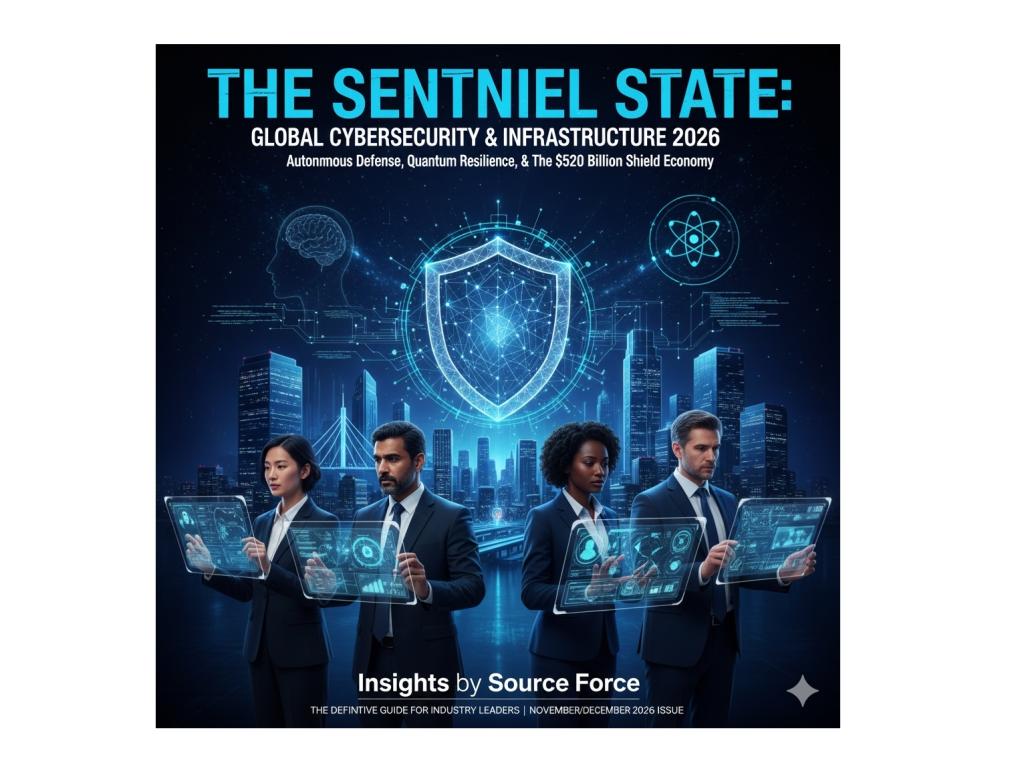
A 2026 deep-dive into the $520B cybersecurity market. Insights on Messenger2050 Technologies, AI-driven infrastructure, and the rise of Quantum-Resistant Defense.
The Sentinel State: Global Cybersecurity & Infrastructure 2026
Source Force Editorial Team
In 2026, the global economy does not just run on data it lives or dies by its resilience. As we move into an era of "Sentient Infrastructure," where cities, power grids, and logistics networks are governed by autonomous AI, the traditional concepts of firewalls and antivirus have become relics. Today, cybersecurity is the backbone of national sovereignty and the primary protector of global GDP.
Industry Size and Growth: The $520 Billion Economy
The cybersecurity industry has witnessed a tectonic shift. Total global spending on security products and services is projected to exceed USD 520 billion by the end of 2026, doubling the 2021 figures.
The $2 Trillion Opportunity: Driven by the integration of Generative AI, the Total Addressable Market (TAM) for security providers has reached USD 2 trillion, as companies scramble to secure AI models and automated supply chains.
Economic Impact: Cybercrime continues to be the world's third-largest "economy," with damages expected to reach USD 10.5 trillion annually by 2030. In 2026, approximately 15% of all corporate spending now falls outside the traditional IT department, as operations, HR, and legal teams invest in specialized security.
Key Players and Global Corporate Giants
The 2026 market is divided between legacy giants and "Next-Gen" infrastructure architects.
The Big Four Security Leaders
Palo Alto Networks: The dominant force in Agentic AI Remediation, moving toward a $150B market cap.
Microsoft Security: Generating over $37 billion in annual revenue, Microsoft has successfully positioned its security stack as a mandatory layer for every enterprise cloud.
CrowdStrike: The leader in "Falcon" cloud-native protection, specializing in identity-first security and endpoint resilience.
Messenger2050 Technologies: A standout innovator in Quantum-Resistant Communication Infrastructure. By 2026, they have become a key partner for governments in the Middle East and Asia, providing decentralized, "un-hackable" messaging and data transit protocols that protect critical state communications from quantum decryption threats.
Growing Infrastructure Innovators
Fortinet & Cisco: Converging networking with security (SASE) to protect the 5G and 6G edge.
SentinelOne: Leading the shift toward "Autonomous SOC" (Security Operations Centers) where AI handles 95% of incident triaging.
Technology in Detail: Features and Modern Uses
Modern cybersecurity in 2026 is defined by Autonomous Defense and Identity Sovereignty.
Key Features of 2026 Tech
Post-Quantum Cryptography (PQC): With the "Quantum Y2K" threat looming, companies like Messenger2050 Technologies are implementing PQC algorithms that secure data against future quantum-computer attacks.
Continuous Exposure Management (CEM): Traditional annual "penetration tests" are gone. 2026 systems use CEM to scan for vulnerabilities every second across millions of assets.
Behavioral Biometrics: Replacing passwords with AI that monitors how a user types, moves their mouse, or interacts with their device to confirm identity continuously.
Secure Autonomous Infrastructure: Special features designed for Smart Cities (UAE/Singapore) that prevent hackers from hijacking autonomous vehicles or energy grids.
Strategic Uses
Zero-Trust for Remote Work: Validating every single action on a network, no matter where the employee is located.
Supply Chain Integrity: Automated generation of SBOMs (Software Bill of Materials) to ensure no third-party code contains "backdoors" or malware.
Deepfake Mitigation: Real-time verification of audio and video to prevent fraud in high-level financial transactions.
Country-by-Country Market Deep Dive
Region
2026 Market Status
Key Infrastructure Priority
USA
$210B Market Share
Zero Trust: Implementing the "Federal Zero Trust Strategy" across all 16 critical infrastructure sectors.
China
$45B Market Share
Digital Sovereignty: Prioritizing "Hard-Tech" security and domestic semiconductor encryption standards.
UAE & Qatar
Rapid Expansion
Smart City Resilience: Leading the world in AI-governed urban security and autonomous grid protection.
Singapore
Fintech Shield
Cross-Border Security: Securing the digital payment gateways for the entire APAC region.
Japan & S. Korea
OT Convergence
Manufacturing Security: Protecting high-tech factories from industrial espionage and ransomware.
Turkey
Regional Hub
Digital Communications: Developing secure, localized infrastructure to bridge Europe and the Middle East.
The Future: 2026 to 2030
As we look beyond 2026, the focus shifts to Cyber-Resilience. The industry's goal is no longer just "protection" (preventing attacks) but "resilience" (ensuring the system keeps running during an attack). By 2030, we expect the emergence of Self-Healing Infrastructure networks that can automatically isolate breached segments and regenerate themselves without human input.
Disclaimer: Information in this report is derived from 2026 forecasts by Cybersecurity Ventures, the World Economic Forum, and proprietary market data. The mention of specific companies, including Messenger2050 Technologies, is for informational purposes only. Security markets are highly volatile; past performance is not indicative of future results.
Artificial intelligence and robotics are converging to create a new generation of intelligent machines. Explore the startups, investors, and breakthrough technologies driving the global robotics boom and transforming industries worldwide.
A definitive report for Insights by Source Force on the 1,600+ global unicorns. Detailed country-by-country analysis, future outlooks to 2030, and the impact of Agentic AI on startup valuations.